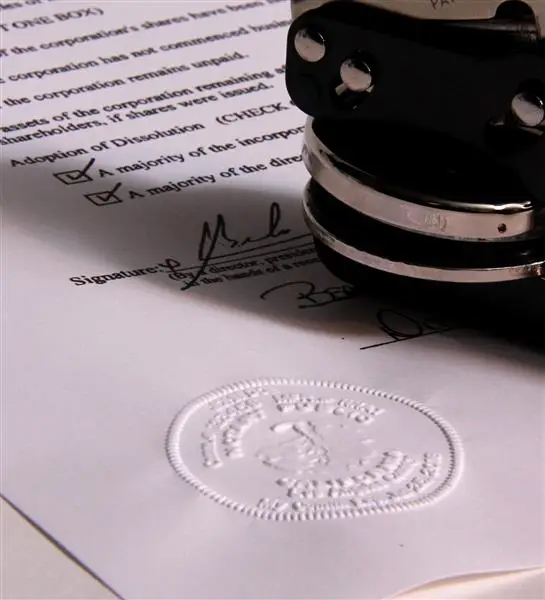
Over time, a notary public will encounter some difficult moments. An example of one is when you are presented with documents that have blank spaces. If you are a new notary, you need to know how to handle this situation. First off, under no circumstances do you want to provide a notarial seal to such a document. Feel free to read our blog on the Notary Official Seal.
This is why. This blank space could easily be filled-in at some point in the future. Doing so can alter the entire intent of the document. As a result, the possibility for fraud becomes evident. This can subject you to significant liability. You may ask yourself what someone could write in a blank space. Well, just about anything. So, your smart course is to refuse notary service. You’ll certainly want to do this in a professional manner. The National Notary Association has a good article on this, as well.
This is of course another resolution. Let’s remember that it is the client’s responsibility to present you with an instrument that is finalized. So, he or she could complete the blank area in order to assure that the instrument is complete. Should they do so, the instrument would then be complete and set to be notarized. But, you are not allowed to advise them as to what they need to enter into the blank space. Please read our article about a Personal Appearance Before a Notary.
Handling Questionable Documents
By blank spaces, we are not referencing the area specified for your notary text. Nor are we referencing any space reserved for the client’s signature.
Another thing to do is to make sure all the pages are there. So, you want to search for any missing pages. If you fail to take suitable measures before applying your seal, you could put yourself in jeopardy of being exposed to serious liability. So, exercise caution.
Simply put, you must shield yourself. Documents that have blank spaces are not the only area to concern yourself with. The best way to shield one self is to have a complete grasp of the Notary Law in the State where you are commissioned. To many of you, this may seem elementary. But what happens to us, as humans, is that after a period of time we may get complacent. So, we need to take a proactive approach because the consequences can be too great. If we develop good habits and take a “best practices” approach, we should avoid the pitfalls that could place us in a liability situation.
Besides writing blog articles, we provide notary training. If you want to become a Notary Public in New York State, our notary exam preparation course can help you. Read our FAQ page to find answers to any notary questions you may have.
What would you do if your notary authentication results in a blotchy notary seal? Right off the bat, I should state that you need to be comfortable with your notary stamp. Maybe you just purchased a new one. To prevent the need to fix a blotchy notary seal, practice using the stamp beforehand. Take a blank paper and exercise some practice imprints. Within a very short time, you will develop a “feel” for the amount of pressure you will need to exert. If you do create a blotchy seal, it is a good idea to make a record of it in your Notary Journal.
Let’s say you’ve notarized countless documents. It still makes sense to do a practice imprint before actually stamping the real instrument. In either case, it’s a good idea to destroy those stamped practice sheets. This will help you to minimze the chanve of a blotchy seal.
It wouldn’t be wise to impress your stamp if the document is sitting on top of a stack of papers. That will frequently result in a blotchy notary seal. You need a level surface to help secure a clear image.
Solving the problem
Okay, let’s return to our issue. We all try to be careful. But let’s admit it, we are human. As such, we WILL make mistakes from time to time. So, let’s assume that you made your impression on the document. Doing so, you created a blotchy seal. Or, maybe you simply created a mark that is weak. Now what?
First off, do not attempt to adjust the original imprint. Here’s why. Consider that some type of legal action happens in the future. The court could consider that something fishy took place.
If you need to fix a blotchy notary seal you can certainly execute another (second) seal. Here, it is vital to note that the second seal cannot cover any of the information that is in the document. Equally, it should not cover the first seal.
Let me say this again. It is smart to practice your imprinting procedure.
A good way to avoid a problem is to think before you begin to put pressure on the stamp. By building good habits, you will go a long way in avoiding the potential of printing a bad impression. Hence, it will be very seldom that you will encounter a smeared imprint. A place to buy your notary stamp is Notary Stamp.com
Don’t forget that as a notary, you need to guard against potential liability. A sure way to do that is to be attentive to the notary law. Another problem a notary may face is when he or she encounters a name irregularity.
This site has many blog articles directed at notaries public. Feel free to visit our FAQ page to get answers to common questions. And, if you’re thinking about becoming a Notary Public in New York State, we will prepare you to pass the notary exam. Our New York Notary Exam course has assisted countless students prepare to pass the test.
If you want to know more about the ins and outs of being a notary, you can watch the YouTube video on Notary Law and Ethics by Michael Closen.
In New York State your commission is in your county of residence. Thus, it is your county clerk who may certify your official character as a notary public. Why would you need a certificate of Official Character? Well, some document recipients may require certification and authentication. It allows a document to be read into evidence. In today’s “let’s Sue” society, the ability to have a document read into evidence can be vital. We have more information on this in our Notary test preparation course.
So, assume you live in Monroe County and in addition to Monroe County you anticipate doing notarial acts in Ontario County. Consequently, You may file your autograph signature and certificate of official character in Ontario County (Or any number of counties, for that matter). Hence, you are registering your commission in another county. We have an article that relates to this. Feel free to read our blog post, Where to Have a Document Notarized.
Another blog article we have, although not necessarily related is, Should a Notary Public Advertise. If you have a certificate of official character in another county, you may want to advertise in that county. That does not imply that with or without a certificate of official character that you cannot notarize in another county. Indeed you can. Rather, we are assuming that you are do considerable business in more than one county. Thus, advertising may prove an additional benefit to your business. Feel free to check it out.
Fees
You can purchase an Office Character Card. You do this from the county clerk in the county where you have been qualified. However, there is a $5.00 fee for issuing a a certificate.
There is a fee of $10.00 to register your commission
Other Facts
The county clerk’s signature can be printed, faxed, stamped, photographed, or engraved on an authentication. So, if you are qualified in Monroe County, and someone in Ontario County needed to verify your signature (Notary Authentication), they would have to travel to the county clerk in Erie County. But, you can make it much easier for your clients by filing a Certificate of Official Character. The key here is: “printed, faxed, etc.
Your certificate expires with your notary commission, which means you would need a new one every 4 years.
Once you receive your Certificate of Official Character, you can submit it to the county clerk (In the case above, county of Ontario). in Ontario County, or any other county. More information on certifying official character is in the N.Y. Notary Public License law, visit New York State, Department of State and search Notary License Law.
Notaries can indeed refuse service. However, a notary should NOT refuse service to perform a lawful notarial act. What if the document violates your personal beliefs? Still, you should not refuse service. Look, you are not endorsing the contents of the document. You are verifying the identity of the signer. Thus, you are simply a third party witness. So, let’s assume you are against same-sex marriages. You are presented with a document where the content relates to this issue. You should not refuse service. The contents of the document are not within your purview. It might be a good time to read our article about Dangerous Questions Presented to a Notary in New York. Again, you are only a third-party witness who verifies the identity of the signer. There are only a handful of instances where notaries can refuse service because of the document’s contents. If a client needs to authenticate a foreign birth certificate, for example, you may need to refer them to an Apostille.
You may wish to check-out some of our other articles from our blog posts. We discuss several topics relating to notarial service.
When to Refuse Service
There are numerous situations where a notary should refuse service. For instance
The signer does not understand the contents of the document, or appears confused.
You cannot properly identify the signer
The signer is not physically present
You believer that the signer is not signing of their own free will. Perhaps they are coerced.
The document contains black spaces
The signer is your family member
The document does not contain a notarial certificate, and the signer cannot instruct the Notary which type of notarial certificate is required
The client wants a certified copy of a public record
As a notary you must remember that you are a public official. As such, your personal feelings cannot come into play. So, you must fulfil your obligation as a public official unless any of the items outlined above become a factor. That National Notary Association has a more in-depth article on this subject.
If you want to become a Notary Public in New York, you can enroll in our NY Notary Exam training.
Yes. To answer the question, “Does a New York notary have liability?”
A notary can be held liable for misconduct. If a notary performs or fails to do so properly, he or she is exposed to liability. The notary may be responsible if such a person is negligent. Although their duties may seem in simple terms, notaries must perform their duties carefully, or they may be held accountable. Their primary role is to authenticate the identity of signatories and witness the signing of documents and administer oaths. Despite Their seemingly straightforward duties, they come with serious potential liability for notaries if the tasks are not performed correctly. The meaning of notary liability is important for notaries. They must perform their duties with due diligence and mitigate risks.
Nature of Notary Liability
Notary liability is the term describing the legal responsibilities of a notary public. A notary is responsible for any mistakes, omissions, or misconduct occurring in the performance of their duties. When a notary commits an error or acts in bad faith, they can be sued and held responsible through civil charges or other legal consequences. The nature of this liability varies in the jurisdictions and circumstances; due circumstances of the case.
For example, you notarized a document without the signer present. Or, you don’t check the identity of the signer. You could also make yourself exposed because you did not perform proper notarial acts. Another point that puts you in the cross-hairs is: You know that a document contains a false statement. However, you nonetheless you go ahead and notarize the instrument anyway. Realize that it is officially misconduct. It could be a matter of criminal or civil liability. You may want to read our article on Notary Discipline.
So, what if a notary makes a minor mistake? You may be responsible for any damages your mistake brings. If you notarize a high volume of documents, getting Errors and Omissions Insurance is prudent. We will address this insurance in an upcoming blog.
Errors and Omissions:
If a notary makes errors or is failing to perform tasks according to the law, this is also an indirect approach to liability. They can be found liable. If a notary fails to validate the signer properly or makes a mistake with the notarization, it can lead to legal problems and a significant financial burden on the parties involved.
Authenticate Documents Properly: Notaries should properly make ensure that all relevant documents are properly executed and comply with any legal requirements. If a notary does not correctly authenticate or verify a document, arguments or even some legal challenges may arise.
Improper Administration of Oaths: When administering oaths, notaries must follow strict procedures. Any deviation from these procedures results in the oath considered as invalid. This impacts legal proceedings or document validity.
Fraud and Misconduct: A notary public is required to act with ethics and refrain from acts of fraud or dishonesty. Engaging in fraudulent acts, like forging documents or intentionally permitting an individual to sign a document can have very serious results. Do not engage in any form of fraud or misconduct. Engaging in fraud, including fabricating documents can have huge repercussions. Your employer will be liable for the notarial acts you perform. The best advice is always to follow the law. All of these situations — and more — are discussed in our New York Course for Preparing for the Notary Examination.
In addition, your employer risks liability for any notarial acts you perform. One possible problem arises when your employer wants to take advantage of your notary status. He or she asks you to authenticate a signature outside the parameters of the law. It may seem a simple favor at the time, but it can come back to haunt you. It is extremely important that both you and your employer understand that improper notarization is not allowed. The best advice is always follow the law. All of these situations, and more, are detailed in our New York notary Test Preparation Course.
Consequences of Notary Liability
The consequences of notary liability can be severe, including:
Legal Action: Any person suffering an injury has the right to take actions and sue the notary to recover any damages emanating from the errors or negligence done. Taking a suit comes along with certain debts within compensatory damages and costs that can be crippling.
Administrative Penalties: Notaries may face disciplinary action from regulatory bodies or licensing agencies. Penalties can include suspension or revocation of the notary commission, fines, and other administrative sanctions.
Loss of Reputation:
There is a risk of enforcement action taken against the notaries for sure violations of the law by all government bodies in agencies, ministries, licensing bodies, commissions or boards. Punishment includes; notary commission being revoked or fined and other administrative disciplinary actions. If the situation demands it, you can also be incarcerated.
Again, a New York Notary has liability. But if you do your job, you will probably not commit misconduct. The law from the New York State Department of State., in short states, ”the best way to avoid exposure to liability is to obey the law.”
So, the best advise we can give you is to conduct your self in a professional manner and follow the law. If you do that, and develop a Best Practices approach, you will minimize any exposure to being liable. At Notary New York, we help prepare you to pass the New York Notary Exam. Our program provides in-depth instruction with sample test questions.