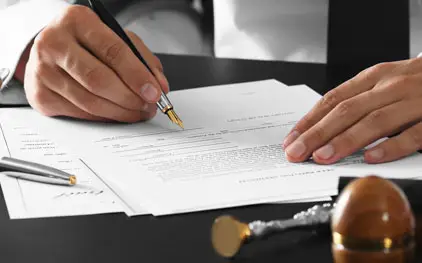
A UPS store may offer Notary Services. However, not every UPS store has a notary on staff when you simply drive to your nearest location to have your document notarized. This can be irritating for customers. Therefore, if you intend to go to a UPS store to have your document notarized, we recommend that you call the location in advance. Making an appointment with the store is the best solution. Some UPS stores require appointments. Most UPS locations are not open in the evenings. In addition, many stores are unlikely to have a Signing Agent, who has different responsibilities from a simple notary public. However, if you require a simple notarization or attestation, a UPS store is certainly an option.
However, as of this writing, FedEx stores do not offer notarizations.
Options for notary services
There are indeed other options are available to have your document notariezed.
Banks
Your local bank branch may have a notary on staff. We recommend that you call first to confirm. Many branches, but not all, have a notary on staff ready to assist you. In addition, if you are a customer, the notary may waive any fees that would apply to the notarial process. Again, call first to save yourself from making a wasted trip.
Mobile Notaries
A quick internet search will help you find a Mobile Notary. In this scenario, the notary will come to you. These services may be more expensive than standard notarization. Mobile notaries can add travel expenses to their fees. Despite the increased expense, you are provided far more flexibility. You do not have to drive anywhere. The notary will come to you. In addition, you do not have to schedule your notarization around store hours.
Remote Notarizations
Many mobile notaries may even provide Remote Notarization, which means the process is done online. Again, the cost may be higher because the cost to the notary is higher, as they have to meet specific costly state requirements to maintain security for the notarization process. But, in some cases, you may have 24/7 access. This offers huge convenience to customers.
Office Depot
Similar to the UPS Store, many Office Depot locations provide notary services. However, many may not; as with the UPS Store, it is recommended that you call your nearest Office Depot store to verify if they have a notary on staff and available.
Conclusion
There are many places where a document can be notarized. Notary service at a UPS store may be a valid option for notarizing your documents. However, as mentioned above, there are other choices. For more information, read our blog article, which highlights more possibilities for getting a document notarized.
For anyone wishing to become a notary in New York, we can prepare you to pass the New York Notary Exam. To learn more, watch the YouTube video.
First of all, you can renew your New York notary license 90 days before its expiration date. Your current license shows what that date is. Another key point is that you must submit your renewal application no later than six months after your license has expired. If you wait, you will be forced to take a new exam, and your current license will be null and void. We recommend that you renew your commission early. This will help to avoid any potential snags. The last thing you want is to have your commission lapse. And remember, you’ll need to submit your $60.00 payment with your renewal application. You may wish to read our article concerning a New York Notary Exam update.
Your Oath of Office
You will have to complete your Oath of Office. Since you are renewing electronically, you will have to complete the application and have it notarized. You will then have to scan it and upload it to the state.
As technology continues to advance, mailing your application has fallen by the wayside. In New York, the state is now requiring an online renewal. This became effective June 20th, 2023. They have created what they call “Business Express.” This is a webpage specifically built to facilitate license renewal, as well as to help people start a new business. We suggest you check it out.
So, you will have to search for the term “Notary.’ Once there, you can search your notary account from your dashboard. Your notary commission ID will be emailed to you once the state processes your application.
You can also update your name, address, phone, etc., from your dashboard. It is recommended that you maintain a current email address with the state. Should you decide to change your email, remember to log into your account and change it with the state.
If you are not a New York notary and wish to become one, we can help. We train people to prepare for and pass the New York Notary Exam. Feel free to read our blog article that shows the New York Exam Sites, and what is expected of you at the exam.
Having a document notarized is an important phase in a number of legal and governmental processes. So then, where does one get a document notarized? Here’s a step-by-step guide that makes it easy for you to comprehend this process.
A comprehensive step-by-step guide is given below to help you navigate through this process.
Where to get a Document Notarized
1. Banks and Credit Unions:
Most banks and credit unions provide notary services to their customers. It may be free, or you may pay a small fee. This is a convenient option because banks typically have notaries available during normal business hours. However, it’s a good idea to check if your branch offers this service.
2. Law Firms and Legal Offices:
Most credit unions and banks will have a notary who will perform a notarization on their client at no extra fee or only a minimal fee. This could be an effective option since most banks have access to notaries within regular business hours.
3. UPS Store, FedEx Office, and Postal Offices
Shipping and postal offices like UPS Store, FedEx Office, and even some post offices offer notary services.
4. Public Libraries:
There are some public libraries with in-house notaries who offer their services free of charge or at a minimal cost. This is especially good for those who want to have a low-cost or public-based option for notarization. But, call ahead at your local library before visiting.
5. Mobile Notary Services:
If you’re unable to visit a notary in person, or if you need a document notarized outside of regular business hours, you can hire a mobile notary. Mobile notaries travel to your location, whether it’s your home, office, or another agreed-upon meeting place, to notarize your documents for a fee. This option offers flexibility and convenience but may be more expensive than other alternatives.
6. Online Notary Services:
With advancements in technology, online notary services have become increasingly popular. These services allow you to get your documents notarized remotely via video call with a commissioned online notary. While this option offers convenience, especially for individuals unable to leave their homes, it’s essential that online notarization is legally recognized in your jurisdiction.
7. Government Offices:
Certain government offices, such as county clerk offices or courthouses, may have notaries available to assist with document notarization. While this option is not always widely advertised, it’s worth checking with your local government offices to see if notary services are available.
Essential points you should keep in Mind:
Identification:
We told you in the beginning of this article. You typically must show a valid identification, such as a driver’s license or passport, or government ID.
Witnesses:
Depending on what type of document you are signing, you may require witnesses over to sign off on the signing.
Fees:
The notary fees differ depending on the service business and where you reside. So, ensure you inquire about the fee first to catch you unaware.
Conclusion:
Be aware, there are choices. Whether you opt for a bank, attorney’s office, shipping facility, public library, mobile notary, online agency, or government office, you should select a solid and reliable provider to ensure the authenticity of your documents. Being aware of your choices and considering your specific needs, you can efficiently go through the process of notarization and proceed with confidence in your legal and administrative endeavors. You may want to read our other article titled, “Where to Have a Document Notarized.”
Finally, we hope you find this article helpful. If you think you want to become a notary, we can help you prepare to pass the New York Notary Exam.
You may ask why one engages a Notary Public. Before we get to that, you should understand that some notaries work in an office location. Others, will travel to meet you. Both provide the same role. The responsibility of a notary is to assure that the signature on a document is true. Given this, it’s necessary that the notary is present when a document is signed. This is important because it helps avoid the potential for legal peril. Thus, this is a benefit to both parties to the instrument. To learn more about notary requirements, in New York, visit the Department of State.
A notary does not, in any way, verify the contents of a document. But, he or she is responsible for validating the autograph of the constituent (the client).
Bear in mind that the term “document” can indicate different things. Quite often, contracts are notarized. And, there are all kinds of contracts: Employment contracts, real estate contracts, etc. However, there are other documents that may need to be notarized. This includes passports, financial instruments, and even certain healthcare items. A big issue for the Notary is to Identify Mental Competence before continuing the notarial process.
Back to our Subject
So, let’s return to our topic. There are distinct advantages for you to engage the services of a notary public. I just alluded to one. It reduces the possibility for fraud. The reason for this is a notary is an impartial party to a document. Because of this, a notary cannot have any interest, or receive any benefit from the document. Otherwise, that notary could be committing malpractice. Every state in the union licenses Notaries Public. And, every state has somewhat different laws that oversee the notarial process.
I hope you are starting to see why one engages a notary public. Engaging a notary is simple. Most branches of banks have a notary public in the building. If you are a bank customer, it would be rare that they charge you a fee. And, any law office can deliver notary service. Even a FedEx or UPS store can provide notarial service.
So, what if you can not travel to your local bank? Well, you could contact a mobile notary public. You can find a mobile notary near you by doing a quick internet search. Be aware that a mobile notary may charge more. That’s because they are allowed to charge to recover their travel expenses.
We have several blog articles that address various notarial acts. We also offer New York State notary exam training. The purpose is to assist people who desire to become a Notary Public in New your State. Our mission is to prepare you to pass the New York State notary exam. If you have any questions about our course drop us an email. Click this link, or hit the contact us tab on our main page.
A notary loose certificate, commonly referred to as a “loose certificate,” is a key document used in the notarial process. This is particularly when an individual requires the notarization of a document not pre-printed with a notarial certificate or when the notarial act is performed on a separate sheet from the notarized document. This type of certificate serves to provide a clear and formal declaration of the notarial act performed, and it plays a significant role in the legal and administrative processes surrounding document verification. Sometimes a document may have a blank space. We have an article on this: Documents that Have Blank Spaces.
Questions about Loose Certificates may appear on the New York Notary Exam. You may want to read our article titled, More About the New York Notary Exam.
Purpose and Usage
So, the primary purpose of a notary loose certificate offers a standardized and legal framework for notarization when the original document does not contain a notarial certificate or when the notarial act needs to be performed on a different page. This is particularly useful in various scenarios:
Documents without Pre-Printed Certificates: Some documents, especially those drafted for specific or informal purposes, may not have a pre-printed notarial certificate. A loose certificate allows for the notarization of such documents without altering the original content.
Separation of Notarial Act from Document: In certain cases, the notarial act might need to be separated from the original document. This provides clarity, or due to the nature of the document. For example, when notarizing multiple copies of a document, each copy might require its own loose certificate.
Structure and Components
A notary loose certificate typically includes several critical components to ensure its validity:
Title of the Document: It should clearly state that it is a notarial certificate.
Notary Public’s Statement: This includes the notary’s declaration that they have witnessed the signing of the document, or have administered an oath or affirmation.
Identification of the Signer: The certificate should identify the individual whose signature is notarized, including details such as their name and possibly their address.
Description of the Document: A brief description of the notarized document is often included to establish a clear connection between the certificate and the document.
Date and Location: The date and location where the notarization occurred must be recorded.
Notary’s Signature and Seal: The notary public’s signature, seal, and any required notarial stamp are crucial for validating the certificate.
Legal Considerations
The use of a loose certificate must adhere to state-specific notarial laws and regulations, which can vary significantly. Accordingly, notaries must ensure that loose certificates comply with the legal requirements of their jurisdiction, including any mandatory language or format. Additionally, notaries should be mindful of the need for proper record-keeping and the retention of records related to the notarial act.
Advantages and Limitations
Advantages:
Flexibility: Loose certificates provide flexibility for notarizing documents. These docs may not have pre-printed certificates or that need to be notarized separately.
Clarity: They help maintain clarity and separation between the notarial act and the content of the document. Therefore, they remain beneficial for legal and administrative purposes.
Limitations:
Complexity: The use of loose certificates can introduce complexity. This is true if the notary is unfamiliar with the process or if specific legal requirements are not met.
Potential for Misuse: Improper use of loose certificates, such as incomplete information or incorrect notarization, can lead to legal complications. Thus, the validity of the notarized document might be challenged.
Summary
In summary, notary loose certificates are a versatile tool in the notarization process. They provide a way to formalize the verification of documents that lack a pre-printed notarial certificate or require separate notarization. Their proper use ensures that the notarization process remains clear, valid, and in compliance with legal requirements. It is essential for notaries to be knowledgeable about the applicable laws and procedures to avoid potential pitfalls. Loose Notary Certificates can be obtained through the American Association of Notaries
We write several articles for both the licensed notary and those wanting to become a notary public in New York State. If you need to prepare for the New York notary exam, we can assist you. Our notary training course helps place you in an outstanding position to pass the exam. Visit our homepage or visit our Frequently Asked Questions page to learn how to become a New York Notary.
There are several types of documents that require notarization. In addition, there are specific types of notarial acts, These acts depend on the dictates of the document itself. Our purpose here isn’t to list all the types of notarization, nor all the types of documents that require notarization. But, we want to give you some insight. Let’s start with the three most commonly notarized documents, or types of notarial acts. Then, let’s look at ways to apply them. If you require in-depth information about becoming a notary in New York, visit New York State Notary webpage for specific Information.
Types of Notarial Acts
Acknowledgements: Basically, an acknowledgement ensures the person signing a document is who they say they are. It acknowledges that they sign of their own free will. The signer should appear in person before the notary to be positively identified. You will frequently encounter the need for acknowledgements in Deeds, mortgages and all types of trusts.
Oaths and Affirmations: At times you have to administer a verbal Oath for the purpose of compelling truthfulness. An oath is a pledge before God (or a Supreme Being). If someone doesn’t believe in a supreme being, the notary can give an Affirmation. In this instance the person swears upon their individual honor.
A Jurat: A signer to a document swears or affirms that the contents of a document are true. That’s the key. They swear to the truthfulness of the document contents. This differs from a verbal swearing as in an oath. Jurats are performed for affidavits and depositions.
For an in-depth understanding of these and other notarial acts you can enroll in our New York notary exam preparation course. You can also read our blog article on Why One Engages a Notary Public.
Situations to perform an Acknowledgements.
Living Trust: Today, more than ever, living trusts appear with greater abundance. During a person’s lifetime they create a Living Trust. This means that they designate a trustee to take responsibility for managing their assets. This is for the benefit of an heir or beneficiary – usually a child or other family member.
Bill of Sale: When ownership of an asset transfers to another party for money, a legal document records the transaction.
Contracts: A contract might outline an exchange of goods or services. All contracts are not necessarily notarized. The more at stake for both parties, the more likely that the contract would require notarization.
Articles of Incorporation: When you start a company you create Articles of Incorporation. These documents should be notarized. Otherwise, if you need to submit them to a legal governing body, they won’t be accepted.
A Deed: When real property transfers, the person or persons that transfer the property must sign the deed. These documents are always notarized. You can learn more about acknowledgements by visiting New York State.Gov. Or, if you wish to become a notary public in New York, you can register to take our New York Notary Exam training course.
Some documents may, on a rare occasion require the need of a Loose Certificate. So, a notary must always be prepared.
Situations to perform an Oath may.
Federal employees, political appointees, judges, and most federal positions require an oath of office. Even postal works take an oath. Jobs that expose you to highly confidential information usually require an oath. If you are requested to perform an oath, you are required to do so by law.
Situations to perform a Jurat.
As we mentioned, the signer swears to the contents of the document. For example, you need to provide an affidavit for probate court. You have to verify your identity. You have to verify a death. In such cases you could have to swear to the document’s contents.
 A UPS store may offer Notary Services. However, not every UPS store has a notary on staff when you simply drive to your nearest location to have your document notarized. This can be irritating for customers. Therefore, if you intend to go to a UPS store to have your document notarized, we recommend that you call the location in advance. Making an appointment with the store is the best solution. Some UPS stores require appointments. Most UPS locations are not open in the evenings. In addition, many stores are unlikely to have a Signing Agent, who has different responsibilities from a simple notary public. However, if you require a simple notarization or attestation, a UPS store is certainly an option.